
ORUUC History
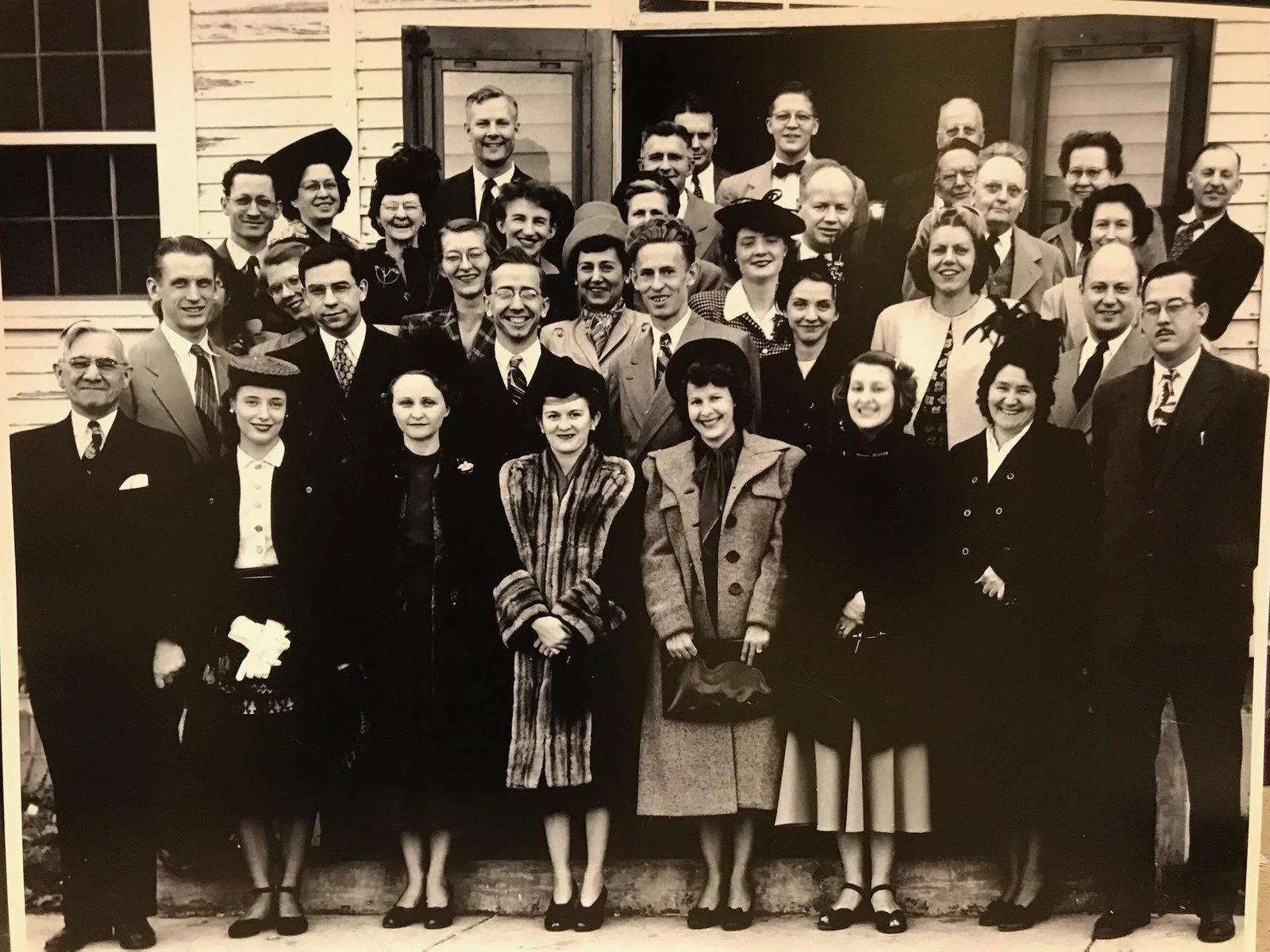
In 1947, a small group of like-minded liberals found one another, and began to meet in homes to discuss their concern for the religious education of their children, and their desire to fulfill their own spiritual needs. Out of that grew Oak Ridge Unitarian Church, incorporated December 23, 1950, and later, in 1983, what we are known as today: Oak Ridge Unitarian Universalist Church.
ORUUC Congregational History
Oak Ridge, Tennessee was built to house the thousands of scientists, professional people, industrial workers and their families brought together from around the United States for the Manhattan Project during World War II. From the earliest days, some felt the need for a liberal religious community here. In 1948, locals formed Tennessee Valley Unitarian Church to serve both Oak Ridge and Knoxville. Rev. Richard Henry directed services in Knoxville on Sunday mornings and in Oak Ridge on Sunday afternoons at the Chapel on the Hill, a church used by many different religious groups in the early days.
In 1950, the Oak Ridge group was officially chartered as a church; Rev. Paul Bliss was installed as the first full-time minister. We met in the City Recreation Hall and in nearby schools. The Religious Education Committee developed a curriculum for the 64 enrolled students. A building & site committee was established. Early church activism in the community led to the establishment of the Oak Ridge Mental Health Association and The Society for Recording for the Blind.
In 1954, Rev. Arthur Graham began a 21-year tenure as our minister. Under his guidance, “Mortar and Bricks in Fifty Six!” became the slogan for the drive to have a building of our own. Fundraisers included sponsoring a professional ballet performance, a production of The Mikado, and a crafts fair.
Members also worked for social justice in the community. A daycare center in the African-American community was set up by the Council of Church Women, with our own Alliance members an integral part of that program. Members also taught high school courses for African-Americans who could not attend the high school before its integration in 1955. Other members were part of a march to protest segregated businesses.
Our first church building, dedicated in 1956, soon proved to be inadequate for our burgeoning church school of 200 children. Some classes were held in the back of the sanctuary while Dr. Graham preached on the other side of a screen. In 1962, additional classrooms were added, and our first paid Director of Religious Education was hired.
Our community actions continued to emphasize integration. Dr. Graham participated in the civil rights marches in Washington and Selma. The church organized an integrated day camp in the summers of 1963-1968 as a means of easing the integration of our schools.
In 1972, a fire severely damaged the church building. During the remodeling, services and church school were held at the Civic Center with occasional journeys to the Arboretum to enjoy worship in a natural setting. In March 1974, we moved back into our remodeled and refurbished church building.
Dr. Arthur Graham retired in 1975. The search committee’s survey of 234 members and 123 friends found that half were 40 to 60 years of age with church school registration totaling 75. In 1976, Rev. Howard Box accepted the call to become our minister. During his 15-year tenure, the changes in the city were reflected in our church. The population decreased; we grew older; more memorial services were held.
All of our ministers have been active in the Oak Ridge Ministerial Association. Rev. Box served as its president and helped to establish an ecumenical Thanksgiving Service and the Ecumenical Storehouse to provide household items for needy families. Our building has been extensively used as a meeting place by other organizations, including some unpopular or unconventional ones. The church has had the Montessori School and the School of Music Arts as tenants during the week, and has been the preferred place for the Civic Music Associations’ coffee concerts and the League of Women Voters.
In 1991, when Rev. Howard Box retired, there were 188 members and 50 children in the church school. Again, the demographics of the city were comparable in our congregation. At that time, the survey indicated our members wanted to find in their religion a foundation for ethical behavior, with more than half looking for spiritual development. Rev. Gregg Carter served as the interim minister as the search committee embarked on its mission to find a new settled minister.
The search brought Rev. Priscilla Richter to our church in 1992. Attendance at the church services increased to the point of needing to hold two services. Rev. Richter brought to the church the newer expressions of spirituality, with more ritual in the morning worship service.
Because of the larger attendance as well as the aging of our 40 year old building, a Long Range Planning Committee was formed to consider the building of a new sanctuary and entry space. Surveys were taken, and member Jon Coddigton’s conceptual drawings were enthusiastically approved. Jon was a Professor of Architecture at the University of Tennessee. About 80% of the costs were raised, mostly by pledges.
Rev. Richter resigned in 1997, after some difficult minster/staff/congregational personnel problems. Following this, the Board and some of the congregation became more aware of the criteria needed for the employment of staff members and became more experienced in the hiring process. At this time, Rev. Don Beaudreault began a two-year interim ministry. In 1999 the congregation called Rev. David Nash Williams to be our settled minister. Although effective and popular with some in the congregation, sexual misconduct and breaches of professional guidelines resulted in the Board’s asking for his resignation.
Again, we faced difficult personnel problems with privacy issues and rumors colliding. Recollection now of this event finds most in agreement that Rev. Williams resignation was necessary. The memory of this period and the lessons learned from it have informed and improved the culture of management in our congregation.
Rev. Diana Heath became the interim minister following this unfortunate period, providing a welcoming understanding of the congregation’s disappointment and anger. Rev. Heath guided the congregation through a period of healing and reconciliation, and we called our new settled minister, Rev. Jake Morrill, in 2003. It was also in 1997 that Tandy Scheffler became our new Director of Religious Education. Tandy would go on to become Rev. Tandy Scheffler and serve ORUUC as our Minister of Care and Connection.
We were privileged to be served by Rev. Jake Morrill and Rev. Tandy Scheffler for two decades. They both retired from ministry in 2022, and ORUUC began ministerial search. Rev. Lisa Romantum Schwartz became our interim minister during the church years of 2022 to 2024. ORUUC called Lóre Stevens as our new settled minister in 2024.
ORUUC continues to be a vibrant, active, and curious spiritual community. We host twice-yearly Rummage Sales, Stone Soup, community events such as ORCMA’s From Rock to Bach, and the Warming Shelter on cold winter nights. Our congregational covenant sings that we are Rooted in Love.